10.22.2012

Internship Journal #4

The final cover for A Veil of Shattered Dreams.
Cover photo and design by Danielle Gesford.
This week, in my internship journal,  I'd like to discuss a few things that have been on my mind for the past few days concerning the different things that I have been working on. These past few weeks I feel I have been most in touch with my novel, A Veil of Shattered Dreams, the one that I am working on for my internship. What seems so strange to me is that in my wildest dreams, I never saw this kind of story escape from me, it is definitely different than anything else that I have ever written and definitely the most difficult.

I think that putting out my cover and realizing the amount of time that I have left to put this novel together has really put the pressure on me to get my writing done. I think that after I finish this story, it may be awhile before I write again. The decision to publish is also something that I have struggled with immensely this week. I never thought that I would publish something like this, especially not in college, my of my writings are for my enjoyment or shorter works that are not ready for publication. However,                 as much as I want to publish it, I want everyone to know that this was never a money making endeavor. Writing is something that I love and something that I want to share with everyone. Reading and the gift of reading is something that I don't believe should be denied to anyone. It is my love of reading, even over writing that propels me to editing and publishing. A belief I hope to retain while I continue even past internship. Secondly, as much as I love the story and the characters, I am no acclaimed author, anything that someone reads from me, published while I am in school, is I think student work. Unless someone sees something in it that I do not see myself.
What I also recognize is the fear that I have in exposing so much of work and writing for everyone to see. It is difficult to have people not only judge your work, but judge you as the author of the work. It should not matter if others like it, I know, as long as I like it. But, if writing has been the one thing that people have anticipated from you, then you do not want to let those people down.

As I start my fifth chapter ( now half-way through) I take these thoughts with me, and I only hope that I can influence my own writing so that I give myself and others the story that they (/I) expect.


10.10.2012

Internship Journal #3

A Veil of Shattered Dreams Cover Version #2.
Still a little more work to be done.
Photo by Danielle Gesford
Model: Caity See
These past few weeks have been the most exciting yet in my internship. At the beginning of the semester, I was learning all of the technical and instructional aspects of the publisher/author, but as time has gone on and I have developed even more of my own project, things have shifted over to the more creative outlet.

Last week alone, I completed another chapter of my novel, now titled A Veil of Shattered Dreams and worked on creating a cover for the novel with help from my two friends. It has been a wonderfully crazy process from setting up a photo shoot, processing and creating all the elements that go into a cover of a book. Though this is only a student project, I can hardly imagine all the revisions, time and creativity that must be put forth to come up with not only the content of the novel, but also how the cover attracts the audience to the novel as well. Design plays a huge role in laying out a novel's format.

I have also spent time with my supervisors helping them with the plots in their own work. I am finding more and more that publishing and novel creation is much more of a collaborative process than I first recognized.

As far as my writing is concerned,  the writing process of Veil is definitely a more challenging endeavor, and I understand why, as most authors do, have so long dates between publication. There is hardly anytime to write. With daily lives and resources and the little unexpected tribulations that pop up,  it is a drastic feat for me to have a decently penned and edited novel in six months. Wow. Writing is actually going to be my major focus for my next journal, as my crunch time approaches and I begin writing very heavily in the next few weeks.

10.01.2012

Lester vs. Vladek, Character Showdown

As those of you who have been keeping up to date on my Comm blog, in my graphic novel class we've been studying different elements of graphic novels and how each element has been contributing to the overall purpose of the comic. Most recently, we've read Art Spiegelman's Maus and the first two books of Jeff Lemire's Essex County. This week, we discuss the characterization of Maus's main character Vladek in comparison to Essex County's Lester.

Art Spiegelman's Maus
We are first introduced to Vladek in Maus through his own recollections and his conversations between himself and his son Artie. Everything that we find out about Vladek are inferences from other characters in the story. Vladek's character is actually presented to us first through the filter of Artie's reactions and dialogue with him.  The way that Artie feels about his father ( overbearing, somewhat ridiculous) influences the way that we as an audience begin to view Vladek. We also understand his compulsive waste-not and thrifty ideals, and his family central lifestyle. Spiegelman illustrates many times  how Vladek came to be who he is, we experience and discover him through his own storying telling. Not only do we come to understand Vladek through Artie, but also through Vladek's own actions in his memories. We hardly ever hear or see Vladek's internal thoughts or feelings. This creates a division in his character, Vladek the narrator and Vladek the father. We are told everything that happens to him throughout his years in the Holocaust, he recalls every memory and therefore we can judge him and understand him based on what he has been through.
Cover of Jeff Lemire's  Essex County

However, Lester in Essex County is presented to the audience in a very different way. Instead of developing his character through the other characters, Lemire gives the audience bits and pieces of information about the character, through memories and facial expressions and his reactions to others. He leaves it up to the reader to fill in the gaps and make their inferences about Lester. Lemire's approach to characterization is a bit more subtle and makes his character feel more relatable. Unlike Vladek, Lester is a bit more complex and difficult to understand. He does not give every detail about his life away to us right away but we must rely on his surroundings and environment to reveal his character.

9.23.2012

Internship Journal #2 My Novel Progress

These past two weeks  at my internship, I have really been experiencing the writer's end of editing. In this journal, my focus will be about my own writing and the progress and experience that I have gained.    We started off the week, by doing a business lunch at Beasely's Books and Eccentricities in Charles Town, WV.  The atmosphere of Beasely's is the perfect place to come together and brainstorm as writers. The walls are lined with libraries of novels and have little reading nooks tucked in quiet corners for the ultimate curl-up spot. My supervisors and I found a great location inside to meet over a small meal. It was definitely a high-light of my week. We set up our laptops and had an editing session.  We also began start analyzing and monitoring the progress on my novel.
Though I do not want to write or be an author,  I have such a greater appreciation and understanding of the different types of writing styles.  I've realized in these past short weeks that you have to have such an open mind for a writing style that is different than you might expect. Proper editing does not change or alter someone's writing style, but it's a balance of finding and interpreting the writing style and seeing how it affects a certain audience. When you are writing, you have to keep in mind your audience and you have to be aware of everything you're writing. As I've seen, that editing is extremely useful for those ideas that don't quite make it outside of your head. Writing helps you recognize the way authors write, and as editors you know how to improve on any writing style.  So far, I have completed my first chapter and am in progress of my second chapter. (of ten chapters)
Web design and the basics of E-publishing also played a role in my activities for the past two weeks. Uploading manuscripts for E-publishing actually requires some knowledge in web design because websites such as Amazon and Nook require some form of HTML coding.

9.17.2012

Comic Transitions and Maus

In Understanding Comics, author Scott McCloud lists six different panel to panel transitions in comics. He defines six transitions from one panel to the next:
1. Moment-to-moment, where relatively little change takes place between the two panels.
2. Action-to-action, where the actions of a single subject are shown.
3. Subject to subject, which transitions between different subjects in the same scene.
4. Scene-to-scene, which "transports us across significant distances of time and space."
5. Aspect-to-aspect, which "bypasses time for the most part and sets a wandering eye on different aspects of a place, idea, or mood."
6. Non-sequitur, "which offers no logical relationship between panels whatsoever."

These transitions help us to understand the relationship between each panel and how we as readers are supposed to view them and interpret them. In the novel Maus, by Art Spiegelman, these transitions are not always obvious to the reader because our brains are  synthesizing their information without even thinking about it! And Spiegelman's work often has panels that are relatively all the same size and shape, which doesn't automatically signal to us that a transition has occurred. We as readers fill in the gaps already!

Moment to Moment transition.
Take these panels here (right), which depicts the main character Artie having a conversation with his father. As you can see, this panel shows moment to moment transition, where there is the subjects Artie and his father hardly change position and there is little left to the readers to have closure on.


Subject to Subject transition
Other times, in Maus, there are subject-to-subject transitions (left), such as  the scene when Artie's father is describing how it was to be a POW of the Nazis. The panels include how they passed the time while imprisoned, which for Artie's father included playing chess with the other prisoners and writing letters to his wife Anja.

Most common in all graphic novels are action to action transitions (bottom center), which are the actions in progression of a single subject.  In Maus, on of the more memorable action-to-action sequences for me was in the POW camp when Artie's father has to go to the bathroom in the middle of the night. However as he goes outside to pee, he is shot at by guarding soldiers and must quickly go back inside before he is shot. The sequence of showing all of these actions together draws your mind to show you how actions and time has passed in this scene.

Action to Action transition
All images from Maus by Art Spiegelman, for educational use only. Taken by Rachel.

Journal #1 Internship

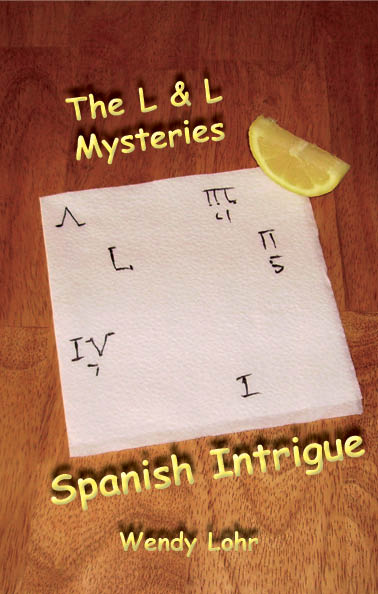
Spanish Intrigue, the first volume of the L&L Mysteries
by Wendy Lohr, one of my supervisors
I’d been planning my internship months before I started it and actually had several opportunities to me with my supervisors ahead of time which was so helpful in working out all the details for this semester. Where I work is a small editing and publishing company out of Gerrardstown, WV called Cressen Books, LLC. Operated out of their home office, Cressen Books, LLC was incorporated in 2010 and since then has published several novels from multiple authors. In my experience, I have been meeting with my supervisors not only to help them edit manuscripts of novels, but also with editing and help to write my own novel. My supervisors thought that it would be important for me to write a manuscript so I would understand first hand what authors go through in novel development all the way up through the editing process. Already, the have been showing me how to use different editing techniques and other programs such as Adobe InDesign, which the Wycloff article mentions is key in a career in Desktop Publishing. As of this week, I am still learning the editing process and how to use Microsoft Word more efficiently for novel and text editing. I have been working many independent hours to write and develop my own novel. I also attended a marketing seminar with my supervisors to gain new skills for their small business. Through these first experience, I have only confirmed that this is definitely the career path that I want to pursue, but I also realized that there is a definite level of professionalism that must be learned in our very relaxed environment. This internship requires alot of personal dedication and hours because I am producing a very personal product.

9.01.2012

Let's Talk about Maus


Just from day one of our Graphic Novel class, I 've learned there is so much that readers and audiences have to learn about comics. There are so many misconceptions and preconceived notions about comics, that a general audience does not realize that the appeal comics have and their role in our lives is so much more apparent than what we know. As Scott McCloud, author of Understanding Comics, notes that comic appeal to us because humans have a tendency to assign identities where none exist, and how not only we make out our world in our image, but how we can project that image on to other symbols and images to better understand the human experience.McCloud argues that audiences pay too much attention to the messenger (of an idea or story) and not the message. In Art Spiegelman's Maus, a novel depicting one experience of the Nazi regime around WWII, Spiegelman uses the idea of assigning human identity to his 'mice' characters, in an attempt to make the audience focus more on story events, rather than the characters themselves. 

Art Spigelman, author of Maus.
Photo by Nadja Spiegelman, 2006

In Maus, all characters are personified mice (though some are other animals, but mice mostly) , though they do have distinct personalities and character traits, I found as a reader that I focused more on the text of the frame, rather than the image to understand what was happening.  I wasn't as focused on their facial expressions, which I think helps me as reader take away more from what characters say. Main character Artie's, father's recollections of the first Nazi takeover in Germany create more of an environment for a reader to lose themselves in, rather than a character's specfic thoughts or motives. The readers do not care that the characters are not human after awhile because it doesn't matter. We've all heard stories about the Nazi regime, and anyone can tell what a Holocaust victim was or looks like. We know as humans the differences in the appearances of our race and the qualities and characteristics that each person is supposed to have. We know what Jews look like, what Aryans look like. But what does a mouse Jew look like? What do we care? All mice look the same to us. We look at the events that Artie's father is retelling, but our lens is different.  Identity is challenged, we are forced to revist our concepts of race, of character. Maus is successful because of the environment that the author has put the reader in. Almost all of the time, readers are forced to make connections with the characters, because we empathize with them as humans do to each other. Very rarely are we forced to make it through a setting or through events by ourselves,  because we can rely on the characters to help us or to guide us. But if we experience it ourselves, we understand what the story is about, what it is trying to present without out filtering out character development or influence, because then it is like "we" experience it
.